Custom Screws and Bolts
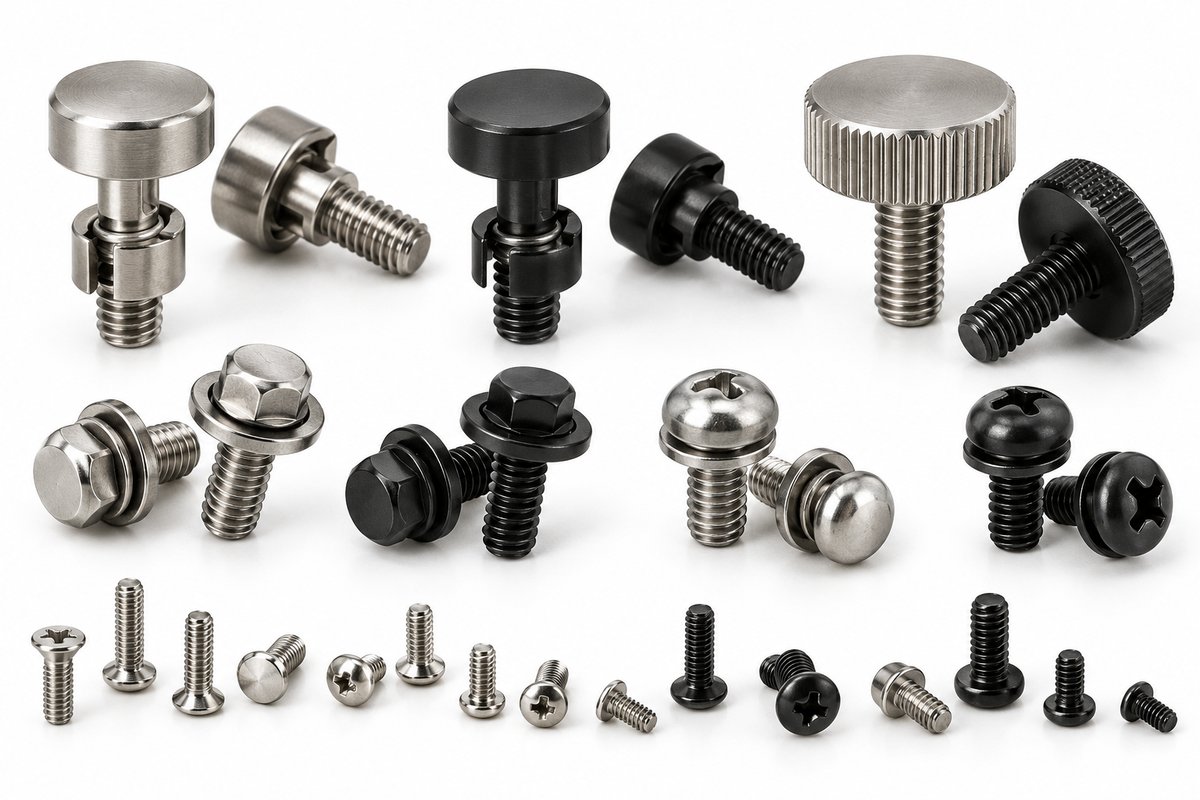
Custom screws and bolts are fasteners whose shape, size, material or finish is not available as a standard ISO, DIN, JIS or ASME part. Typical changes include head shape and height, thread length, stepped shanks, captive washers, special drives, and special materials or coatings.
Common custom fasteners
| Type | Description |
|---|---|
| Captive screws | Reduced shank so the screw stays in the panel when loosened |
| Sems screws | Screw with a pre-assembled washer to cut assembly time |
| Micro and precision screws | Small diameters for electronics and optics |
| Shoulder screws | Precision unthreaded shoulder → shoulder bolts |
| Special heads | Low or thin heads, large heads, knurled heads, tamper-resistant drives |
| Special materials | Titanium (titanium bolts), brass, aluminum, 316 stainless, heat-resistant steels |
Choosing the process
- High quantities (typically thousands and up) → cold heading plus thread rolling for low piece price and strong threads. → Cold heading
- Low quantities, complex or large parts → CNC turning; no dies needed and well suited to prototypes.
- Combination → turned shoulders or heads with rolled threads.
What to specify on the drawing
| Item | What to include |
|---|---|
| Thread | e.g. M6×1, #10-32 UNF; class of fit (6g, 2A…) |
| Thread length | Including allowable incomplete thread |
| Head and drive | Dimensions and drive type (Phillips, hex socket, hexalobular, tamper-resistant) |
| Material and grade | e.g. alloy steel class 10.9, 304 stainless A2-70 |
| Finish | Type, color, thickness, corrosion requirement (salt-spray hours) |
| Inspection | Thread gauges, dimensions, hardness, tensile tests and records |
FAQ
What is the minimum quantity for custom screws?
It depends on the process. Turned screws can be quoted in small quantities and prototypes. Cold heading needs dies, so it becomes economical at higher volumes. Tell us your quantities and we will suggest a route.
Can you copy a sample screw?
We can measure a sample and draw it up, but material, property class and finish must be specified separately. For critical parts, approve a drawing before production.